 English







First Brands: What the headlines miss – And what Supply Chain Finance (Payables) really means

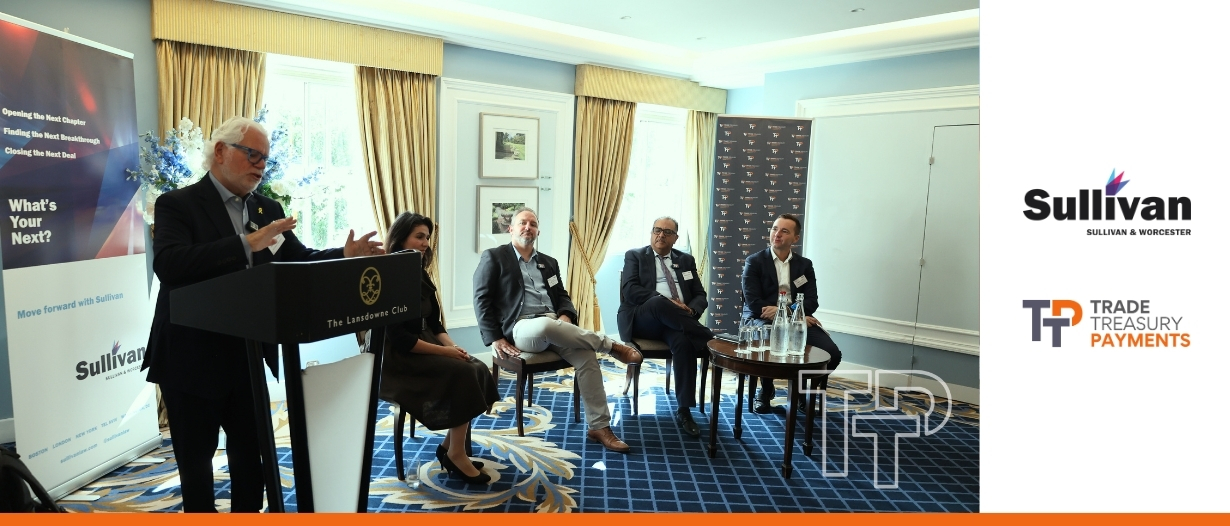
At the Lansdowne Club in London on 15 July 2025, Trade Treasury Payments (TTP), in collaboration with Sullivan, held our first-ever Breakfast Club. With the scent of coffee still hanging in the air, a select audience gathered to explore a deceptively simple question: Who can really grow supply chain finance, and how?
Moderated by Geoffrey Wynne, Head of Trade and Export Finance at Sullivan, the panel featured leaders from Citi, the EBRD, Mercore, and Sullivan. The discussion was introduced by Eleanor Hill, Treasury Editor at Trade Treasury Payments, and centred around one of the sector’s most persistent dilemmas: despite decades of innovation, why has supply chain finance (SCF) failed to meaningfully close the SME trade finance gap?
The conversation began with a recognition that SCF is now an established tool, but only for some. As Geoffrey Wynne said, “The reality is you can only grow it so far if you only have a limited number of buyers.”
Expanding beyond that core group, particularly into SME supplier networks, requires a fundamental rethink. For Citi, this meant lowering the barrier to entry. “We brought down the threshold of who could be onboarded as a supplier,” said Parvaiz Dalal, Global Head of Payables Finance at Citi. “Previously, we said any supplier who has five million or more [in turnover] can be onboarded. We brought it down to one million.”
That move has contributed to material growth. “In the last five years, the business has doubled. We’ve gone from a $50 billion business to $100 billion in five years. And it’s not just because of digitisation, it’s because of removing the friction and enabling the onboarding of suppliers,” Dalal explained.
Yet scale is not simply a matter of lowering thresholds. As Marco Nindl, Senior Banker at the EBRD, noted, context matters. “We started doing SCF in Georgia and Armenia around 10 years ago and it didn’t work. The market was not ready.” Even with the right intentions and access to capital, results were limited until the surrounding ecosystem matured.
This tension (between capacity and readiness) resurfaced throughout the conversation. As Anthony Wadsworth-Hill, CEO of Mercore, added, building that readiness starts with education: “There’s a huge amount of education required. It’s not just about technology, it’s about understanding contracts, it’s about understanding how payment mechanisms work.”

While digital transformation is often touted as the panacea, speakers were measured in their assessments. “Everyone’s talking about digitisation, but I think we should start with what that actually means,” Dalal said. “It’s about onboarding suppliers using digital documents. It’s about doing the legal due diligence using digital platforms. It’s about using AI to go through the contracts so you don’t need a lawyer to go through everything manually.”
Citi’s model has already been rolled out globally. “We’ve built a platform which works in 83 countries. That means that the supplier in Thailand or Peru or Canada can get the same experience,” said Dalal. But global consistency doesn’t guarantee universal access. The underlying infrastructure – especially in terms of compliance – often lags behind.
Nindl described the EBRD’s experience with this digital divide: “We work with over 100 banks in 35 countries. In a lot of these banks, the IT is not there, and the KYC is still paper-based. You want to onboard a new client, and it takes three weeks, even for a small transaction. So we started to work with a couple of fintechs to build a small onboarding tool for the client.”
Wadsworth-Hill echoed this gap: “What we see is that the technology is there, but the mindset often isn’t. Banks have product governance cycles that can be 12 to 24 months long. By the time a product is approved, it’s already obsolete.”
The panel returned repeatedly to the core principle that if technology doesn’t reduce friction for the supplier, it doesn’t serve its purpose. As Dalal said, “We built everything from the supplier’s point of view. The supplier doesn’t want to know about supply chain finance. They just want to get paid.”
A less visible (but no less important) barrier to scale lies in legal documentation. According to Daniela Barrdear, Partner at Sullivan, “It’s often not the lawyers who are the bottleneck. It’s the documents themselves.”
Much of the documentation used in SCF today, particularly for guarantees and participations, has been adapted from older templates designed for different products or counterparties. “You’re looking at documents that are a Frankenstein of multiple different banks’ requirements, multiple jurisdictions, and then trying to figure out how to make that work for both the DFIs and the commercial banks,” Barrdear noted.
This lack of standardisation slows execution and increases transaction costs, particularly in blended finance structures where DFIs and commercial banks are participating together. “We’re talking about four or five different templates. One for onboarding, one for participation, one for guarantee issuance, and then another for the DFI piece,” she said.
The solution isn’t to reinvent everything, but to modernise and align. “There are industry templates already that can be updated. We don’t have to start from scratch. But we do need to have a conversation about what actually works operationally, not just legally,” said Barrdear.
Wynne closed the topic with a pointed reminder: “If the documentation doesn’t allow the deal to move quickly, or the guarantee to stay on cover, you haven’t solved anything.”
All panellists agreed that no single actor – bank, fintech, or development bank – can close the SCF gap alone. Naturally, this makes partnerships essential.
Dalal spoke about Citi’s approach, saying, “We’re working with fintechs who are doing ESG scoring. We integrate those scores into our supply chain finance platforms. So if you’re a supplier that has a better ESG rating, you get a better rate.”
For Mercore, collaboration means acting as a bridge. “We see ourselves as an originator and a processor. We’re not a bank, but we partner with banks. We use technology to structure and package the receivables, and then we syndicate it,” explained Wadsworth-Hill.
The EBRD, meanwhile, is focused on capacity building and risk-sharing. “We’re providing technical assistance to banks to help them understand how to onboard suppliers digitally, how to reduce KYC friction,” said Nindl. “But we also provide capital, like risk-sharing lines and unfunded guarantees that allow those banks to stretch their risk appetite.”
The common thread is alignment. Whether through data integration, shared infrastructure, or legal harmonisation, collaboration only works when parties understand each other’s constraints and are willing to adapt.
The TTP Breakfast Club panel didn’t promise easy fixes, but it did clearly identify what’s needed: simplification, education, and collaboration.
As Dalal said, “This isn’t about innovation for the sake of it. It’s about solving real pain points.”
For those who missed the event (or want to revisit the full conversation) the complete panel discussion is now available on the TTP Podcast.

Oct 17, 2025

Oct 16, 2025


Oct 16, 2025

Oct 16, 2025


Oct 15, 2025

Trade Treasury Payments is the trading name of Trade & Transaction Finance Media Services Ltd (company number: 16228111), incorporated in England and Wales, at 34-35 Clarges St, London W1J 7EJ. TTP is registered as a Data Controller under the ICO: ZB882947. VAT Number: 485 4500 78.
© 2025 Trade Treasury Payments. All Rights Reserved.