 English



First Brands: What the headlines miss – And what Supply Chain Finance (Payables) really means

 Carlos Kuriyama
 Carter Hoffman
Sep 16, 2025
Carter Hoffman
Sep 16, 2025
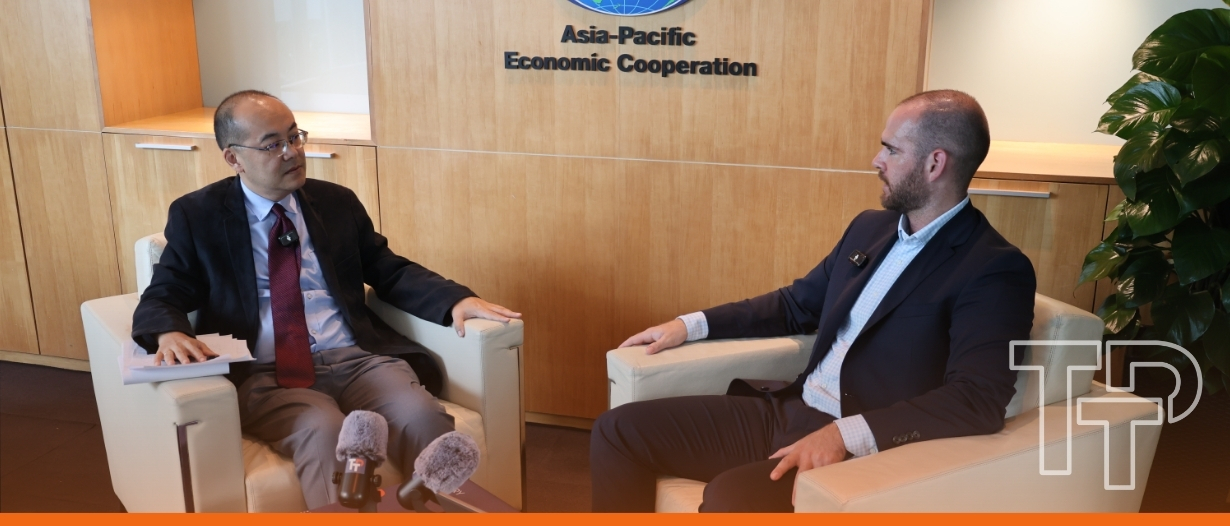
TTP’s Trade Editor Carter Hoffman sat down with Carlos Kuriyama, Director of the Policy Support Unit at the Asia-Pacific Economic Cooperation (APEC) Secretariat in Singapore, to discuss how APEC is shaping the future of cross-border trade.
From streamlining trade through digitalisation to strengthening supply chain resilience and fostering inclusive growth, Kuriyama offers insight into APEC’s evolving priorities.
In its early years, APEC focused heavily on trade liberalisation, removing tariffs and opening markets. Today, that focus has broadened toward trade facilitation and structural reform. “A lot of the work we do now is about trade and investment facilitation and business facilitation in general,” Kuriyama said, noting that while market opening is still on the agenda, there is greater emphasis on making trade easier, faster, and more resilient.
This includes efforts on investment facilitation and behind-the-border structural reforms aimed at bolstering economic resilience.
One buzzword in these discussions is resilience. Kuriyama observes that firms are rethinking how they do business amid geopolitical tensions and pandemic aftershocks.
Many have shifted from a “just-in-time” model of global sourcing to a “just-in-case” model, building redundancies into supply chains even if it means higher costs.
“Building resiliency is more costly,” he said, as companies weigh long-term resilience versus short-term profits. This mirrors a broader trend: adopting a just-in-case inventory strategy, maintaining extra stock and backup suppliers, boosts preparedness at the expense of higher operational costs. The trade-off is now front and centre in APEC discussions.

The push for resilience comes as businesses navigate an environment of mounting uncertainty. Kuriyama points out that policy shifts and external shocks have made firms keenly aware of vulnerabilities in far-flung supply chains.
Recent data demonstrates this, in early 2025, exports from many countries surged as companies front-loaded shipments ahead of anticipated new tariffs, temporarily boosting trade volumes. This rush to get ahead of restrictions underscores how jittery the climate has become. “We are facing increasing uncertainty,” Kuriyama said, and both governments and businesses are looking for ways to “bring more certainty” to the system.
Ensuring a stable, transparent trade environment is crucial for economic resilience. APEC’s role is to facilitate this stability by encouraging its 21 member economies to reinforce openness, coordination, and long-term reforms for a “resilient and sustainable regional economy”.
One of the most concrete ways APEC is boosting efficiency and resilience is through digital trade initiatives. Kuriyama highlights the enormous inefficiencies in today’s cross-border transactions: a single international trade shipment might require 10 to 20 different paper documents interacting with 20+ entities. In fact, as much as 75% of the information on these forms gets re-keyed into multiple systems, creating redundancy and opportunities for error.
APEC economies are working to change this by digitising trade documentation and procedures. The vision is to move toward “paperless trade” where exporters and importers can obtain all necessary permits and certificates through a single online portal (so-called single windows), instead of shuffling paperwork across various agencies. “How about if we try to get those permits from just one central portal? It will save a lot of time and resources,” Kuriyama said, emphasising the appeal of one-stop digital platforms.
The potential gains from trade digitisation are huge. One APEC study estimated that fully digitising trade documents and processes could yield trade gains of USD 5–11 billion in the Asia-Pacific by cutting costs and delays. Another analysis found that adopting paperless trade platforms has already reduced exporting firms’ total trade costs by 3.8% on average, and in 2021 alone, digital platforms contributed USD 383 billion in additional trade across selected APEC economies.
APEC is encouraging members to update laws and regulations to recognise digital documents. “One way to facilitate paperless trade is to have regulations that give equivalent value to digital and paper documents,” said Kuriyama.
In many jurisdictions, an electronic document still lacks the same legal standing as a paper original, a significant barrier to fully paperless trade. APEC governments are working to close this legal gap by aligning with international frameworks like the UNCITRAL Model Law on Electronic Transferable Records (MLETR), which provides for the legal validity of electronic commercial documents.
In fact, following a recent APEC summit (the 2024 “Machu Picchu Declaration” in Peru), members agreed to pursue MLETR adoption so that critical trade documents like bills of lading can be used in digital form across the region. This regulatory alignment, alongside efforts to improve cross-border data standards and interoperability of single window systems, is paving the way for a new era of paperless trade in the Asia-Pacific.
APEC isn’t working in isolation on the digital trade agenda. Kuriyama points out active collaboration with other global bodies such as the World Trade Organization (WTO) and the International Chamber of Commerce (ICC) to promote digitisation. All these institutions share a common goal: to move toward paperless trade and convince both governments and firms of the benefits. For example, the Digital Container Shipping Association (DCSA), representing 75% of global container carriers, has committed to 100% electronic bills of lading, and it worked with APEC officials by sharing findings on legal obstacles to e-document adoption.
When asked about sustainability, Kuriyama offered a broad definition. To him, sustainable growth means being able to use resources continuously over time, whether those resources are environmental or financial. In APEC’s context, sustainability often goes hand-in-hand with inclusivity, ensuring that the benefits of growth are widely shared and long-lasting. One practical focus area is empowering small and medium-sized enterprises (SMEs), which are the backbone of all APEC economies. “In terms of inclusion, SMEs…” Kuriyama said that they often face greater obstacles than large companies, especially when it comes to financing.
Access to credit remains a chronic challenge for smaller firms. SMEs typically pay much higher interest rates on loans than big corporates, reflecting banks’ perception of them as riskier borrowers. They also struggle with a lack of collateral and limited credit history, making banks reluctant to lend. The result is a financing gap that stunts SME growth.
By improving access to finance, APEC economies seek to cultivate a more inclusive growth where even the little players have a shot at success. This inclusivity is a core element of APEC’s vision for “strong, balanced, sustainable, and inclusive” growth, aligning economic objectives with social development.
The patterns of trade in the Asia-Pacific are in flux, and APEC is closely watching these shifting trade flows. One noticeable trend is the growth of “South-South” trade and connector markets, in other words, developing Asian economies trading more with each other. “There is a lot of activity within Asia,” Kuriyama said.
In fact, intra-Asia trade has remained robust even as global trade faced headwinds. Recent analyses show that nearly 60% of the Asia-Pacific’s exports are now within the region itself, reflecting deepening regional integration. DHL’s Global Connectedness Index also finds Asia-Pacific markets are strongly interconnected, with at least 70% of countries in the region having the majority of their top trade partners within Asia.
Simply put, Asian economies are trading heavily with each other, which helps cushion them against slowdowns in Western demand.
A wave of new trade agreements and partnerships is further reinforcing this intra-regional dynamism. Kuriyama said that governments are keen to diversify trading relationships, “it’s not good to have all the eggs in one basket,” as he says, and we see this in the flurry of trade deals being struck or expanded.
Cooperation as the path to certainty
Carlos Kuriyama returned to the fundamental challenge facing today’s global economy: uncertainty. Whether it’s unpredictable policies, geopolitical frictions, or the aftereffects of a pandemic, uncertainty can paralyse businesses.
Organisations like APEC provide a platform for economies to build trust, by sitting together, hashing out differences, and committing to common rules and standards, countries can reduce the “unknowns” that deter investment and growth. “If we find a way to bring more certainty, that’s going to help a lot of the economy, and help us create jobs,” he said.
In practice, this means doubling down on dialogue and coordination. Whether it’s digital trade rules, environmental standards, or financial regulations, working together yields clearer and more stable expectations for all players.

Oct 17, 2025

Oct 16, 2025


Oct 16, 2025

Oct 16, 2025


Oct 15, 2025

Trade Treasury Payments is the trading name of Trade & Transaction Finance Media Services Ltd (company number: 16228111), incorporated in England and Wales, at 34-35 Clarges St, London W1J 7EJ. TTP is registered as a Data Controller under the ICO: ZB882947. VAT Number: 485 4500 78.
© 2025 Trade Treasury Payments. All Rights Reserved.